
The alumnus's decade-spanning exhibition, Historia Sintética, opened with a career-defining painting made during his time in Corsicana.
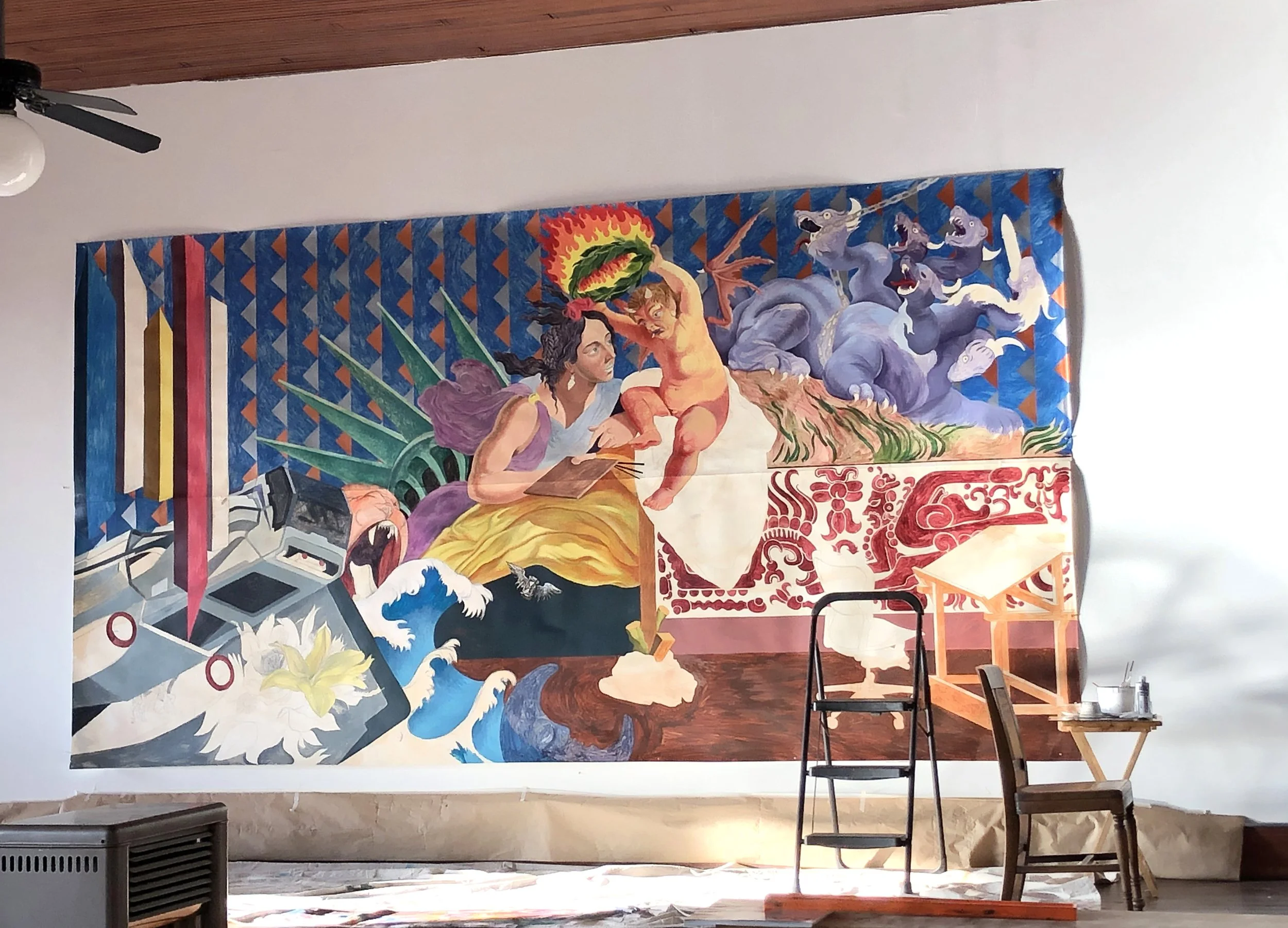
The Artist’s Journey, acrylic on paper, 2020
Francisco Moreno's recent exhibition, Historia Sintética, his first museum survey, was on view at Dallas Contemporary April 17–August 30, 2026. Curated by Thomas Feulmer, curator at The Warehouse Dallas and Corsicana Residency board member, it gathered nearly 50 works spanning more than 10 years of the artist’s career, tracing his path from dense, encyclopedic early canvases to the mural-scaled, narrative “history paintings” that have since defined him.
Positioned at the entrance, The Artist's Journey, a large painting on paper made during Francisco’s residency in Corsicana, offered a crucial key for viewers. Read left to right like a mural, the piece functions as an autobiography: imagery from his mother's Mexico City neighborhood gives way to a spaceship layered over Hokusai's The Great Wave, symbolizing the artist’s migration to Texas over the Rio Grande; a female allegory of The Painter is ambiguously crowned by a devilish cherub; finally, an ordinary drafting table ringed with Mesoamerican symbols welcomes the solitary artist who must do the work.
According to Feulmer, the work represents a genuine turning point in Francisco’s practice and career. It marks the moment he began building his “history paintings” in contrast to the density of earlier pieces like The Chapel, acquired by the Dallas Museum of Art, which formed what the artist calls compressed archives: imagery gathered and questioned but not yet arranged into a single narrative or cosmos. The Artist’s Journey set a distinct visual universe in motion. “It’s the first piece you see, shown not chronologically like the rest of the show is, because it’s his autobiography, his life as an artist. [The idea was] to introduce the ideas that are buried there in the beginning.”
Feulmer credits Corsicana with giving Francisco the space, both mental and physical, to make the leap: room enough, finally, to step back and see the whole painting at once.